Introduction:
My first encounter with the memory of Benjamin Franklin (other than being taught a little about US history at school) was during my first visit to the USA many years ago. We had been shown to our room, and the porter having delivered our bags was clearly waiting for his tip. I had kept by a supply of one dollar bills just for this purpose. I pulled one out and handed it over to the porter. He looked at it and his face lit up – “A Benjamin!” he exclaimed, “Thank you so very much, sir! “
“A what?”, said I, in reply.
“A Benjamin, sir. A Benjamin Franklin, our slang for a one hundred dollar bill. One of our presidents – his face is on the back”.
And off he went, grinning. We got good service for the rest of that stay. I hadn’t really meant to give him a hundred dollars, being very tired after a long trip out, and of course US banknotes are all the same colour!
He was mistaken though in one respect, as Benjamin Franklin was never President of the United States, but neither of us knew that at the time. I only found this out later. The only presidency that Franklin ever held was that of President of Pennsylvania, between 1785 and 1788.
After I retired in 2011, I was able to spend more time developing my interest in local and world history among many other activities. I became especially interested in the 18th century, which was a century of great change in Britain, especially on the industrial front as well as in the rapid expansion and consolidation of the Empire. At a local level, Derby and Derbyshire were at the very centre of the Industrial Revolution. Reading about this, certain names continually crop up – Arkwright, Strutt, Hutton and so on. Other, less expected names also crop up, including Benjamin Franklin, one of America’s Founding Fathers and whose portrait is to be found on the hundred dollar bill. Franklin had friends in Derby and Derbyshire and visited them on several occasions during the twenty or so years he lived in England.
Franklin was clearly a very interesting and highly talented individual, and I decided to do research into his life with an additional focus on his time in Derby and Derbyshire. A summary of this is to be found here on this Website.
Summary of the Life of Benjamin Franklin:
Benjamin Franklin was born on the 17th January 1706 in Boston, Massachusetts, British North America. His father, Josiah, was a soap and candle-maker from Ecton in Northamptonshire, England who had emigrated to Boston in 1683. There, his first wife died, and Benjamin Franklin was the product of a second marriage. Josiah Franklin had converted to Puritanism in the 1670s.

After being brought up and educated in Boston, and at the age of 17, Benjamin Franklin moved on to Philadelphia in Pennsylvania. Here he found a job in a printing house. He must have already been at least a little well-connected, because he was persuaded by the Governor of Pennsylvania to go and get some experience in London, which he promptly did, finding a job as a typesetter in the Smithfield area. He returned to Philadelphia in 1726.
By 1728, Franklin had set up his own printing house, in partnership with Hugh Meredith. He then quite quickly went to become the publisher of his own newspaper. In 1731, Franklin became a Freemason. Using his experience and position as a publisher, Franklin went on to become the author of various publications in the form of books and magazine articles. He also wrote his autobiography in 1771, a little too early to capture his greatest achievements.
Benjamin Franklin was an inventor of some renown, credited with the invention of the lightning rod, bifocal glasses and a flexible urinary catheter – amongst other things. In 1756, Franklin was elected as a Fellow of the Royal Society. He carried out an awful lot of experiments.
Having made a lot of money from his businesses, Franklin was able to move on to a life devoted to public service, becoming a Justice of the Peace in 1749 and then being elected to the Pennsylvania Assembly in 1751. In 1753, he became the deputy postmaster-general for British North America.
From the mid 1750s to mid 1770s, Franklin spent a lot of time in London. This was meant to be some sort of political mission, but Franklin spent a lot of time with scientists, industrialists and other notable people. Using London as a base, Franklin toured all over Britain and Ireland. He also travelled to Germany and France. He saw the poverty in Ireland as a result of an oppressive British rule and became fearful that this might be repeated in British North America.
There is very little doubt that Franklin saw himself as an Englishman first and foremost for most of his life, and at all times before the 1770s made a hundred percent effort to maintain the link between the North American colonies and the mother country. In 1775, Franklin abandoned this stance after it became quite clear that the British government was determined to rule and tax these colonies quite harshly and with no room for compromise.
In June 1776, Franklin was appointed to the Committee of Five that drafted the Declaration of Independence. The Second Continental Congress had established the US Post Office the year before and appointed him as the first US Postmaster General. Between 1776 and 1785, Franklin moved to France and became the US Ambassador there. He, therefore, was not involved in any of the fighting in the Revolutionary War. He negotiated the Treaty of Paris (1783) which ended that war.
In 1785, Franklin returned to the US to become the President of Pennsylvania. He died five years later in Philadelphia, age 84, on the 17th April 1790. He is buried there.
Benjamin Franklin in Derby and Derbyshire:
During his lifetime, Franklin made four journeys across the Atlantic to England and Europe.
The first was when he crossed to England in 1724, spending 2 years there before returning to the New World in 1726. Most of his time in England was spent in the London area.
The second was in 1757 – that is 31 years later. He stayed in Europe for 5 years before returning home. Based in London, he went on several “rambles” around England, visiting Derby and Derbyshire during two of these (1759 and 1760). He also went on a “ramble” to the European continent, visiting what is now modern Holland and Belgium.
His third crossing was to bring him to England in 1765, returning to America in 1775. Two more of his many “rambles” during this time brought him to Derby and Derbyshire (1771 and 1772).
The fourth and final time, Franklin left America was to last from 1776 to 1785. He sailed directly to France and spent the whole of his time there, as described above.
Benjamin Franklin had many influential friends in all parts of Great Britain. The three most influential of his acquaintances in Derby and Derbyshire were Anthony Tissington, John Whitehurst and Erasmus Darwin. He corresponded with these people before and after his “rambles” and of course visited them while “rambling”. It should be noted here that Franklin didn’t actually walk – he had hired a private coach with horses. He originally met most of his British contacts in London and Birmingham (via his membership of the Lunar Society in the latter city).
Anthony Tissington, who lived at Swanwick Hall was born in Darley Dale into a mining family and by the end of his career controlled coal, ironstone and lead mines throughout England, Wales and Scotland.
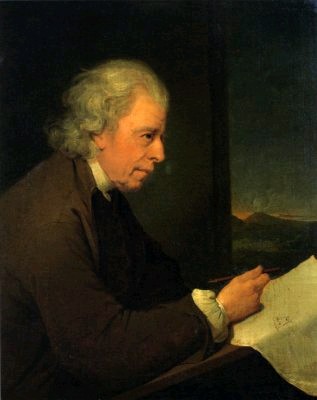
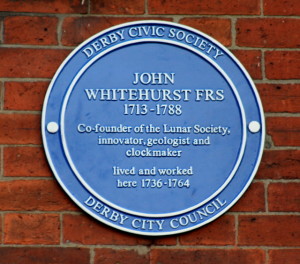
John Whitehurst was born in Congleton in 1713. His father was a clockmaker. He entered into business for himself, also as a clockmaker, in Derby in 1736. Although Whitehurst’s main business was clockmaking, he also made thermometers and barometers and was an expert in pneumatics and hydraulics. He moved his business to London in the 1770s, having spent 44 years working and living in Derby. The house, where he first set up business still stands in Irongate, Derby. He later moved to Queen Street, although this house has been lost.
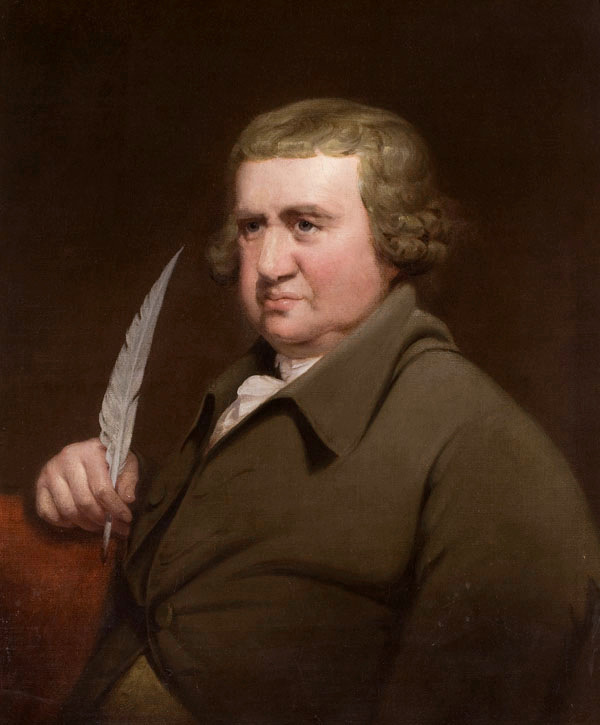
Erasmus Darwin (1731 to 1802), was the grandfather of the better known Charles Darwin. He was a physician, poet and philosopher among other things. He lived in Full Street, Derby for a while before moving to Breadsall Priory, where he died in 1802. He is buried in All Saints Church, Breadsall.
Franklins first “ramble” through Derbyshire was made in 1759, but the exact route is unclear. He was on his way to and from Scotland. It is apparent that he met and stayed with John Whitehurst in Derby and stayed with Anthony Tissington in Alfreton.
In 1760, he came through Derbyshire again, but the route is unclear.
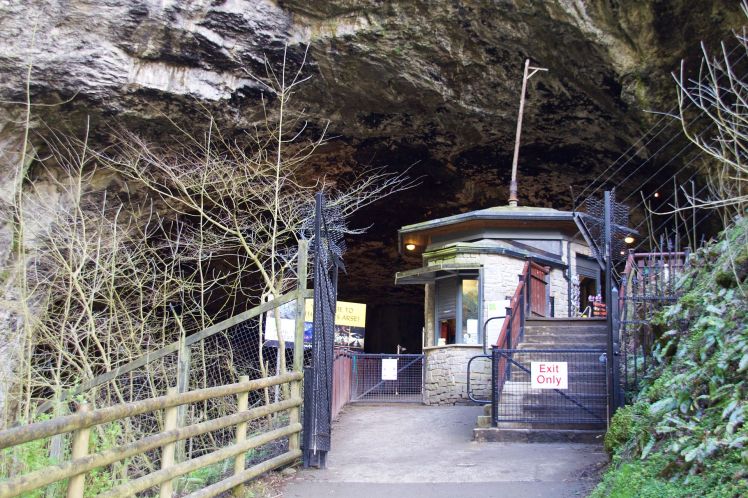
In 1771, Franklin made a tour of the industrial North (of England) and Midlands. From London, Franklin travelled via Leicester to Derby then to Manchester and Leeds, returning to Derby via Sheffield and thence back to London via Birmingham. The outward journey from Derby appears to have gone via Matlock Bath, Bakewell, Ashford-in-the Water, the Peak Cavern (then known as the “Devil’s Arse”) and Buxton. The return journey from Sheffield appears to have gone via Chatsworth House, Bakewell, Matlock Bath and Alfreton.
At Ashford-in -the -Water, Franklin’s party visited Henry Watson’s Marble Mill.
The “Devil’s Arse” (renamed to “Peak Cavern” for a later visit by Queen Victoria) was toured. They found people living in there.
On the way back, and in Derby, they visited Derby China Manufactory – later to become Crown Derby, thanks to George the Third’s patronage. That same day, they had a look round the Silk Mill in Derby.
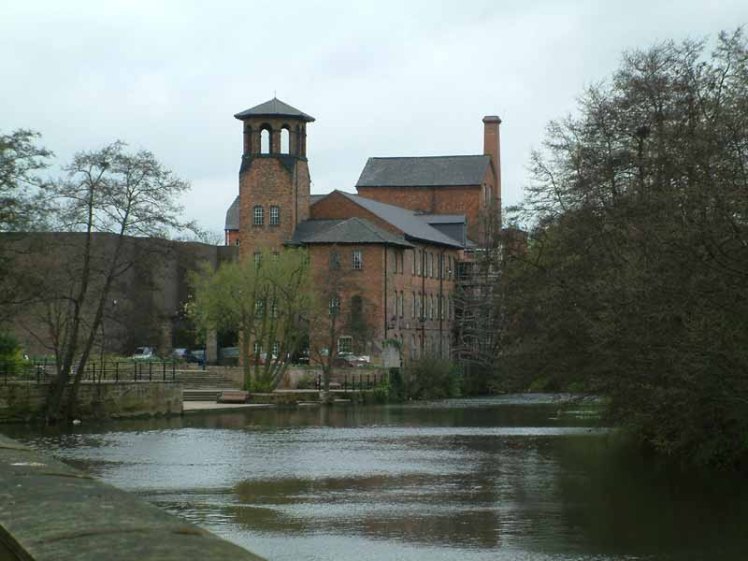
The “rambles” of 1772 almost certainly involved passing through Derbyshire, but the exact route is unclear.
Dr Philip Dodgson, Derby, January 2024.
 DR PHILIP DODGSON of DERBY on BENJAMIN FRANKLIN in DERBY and DERBYSHIRE